
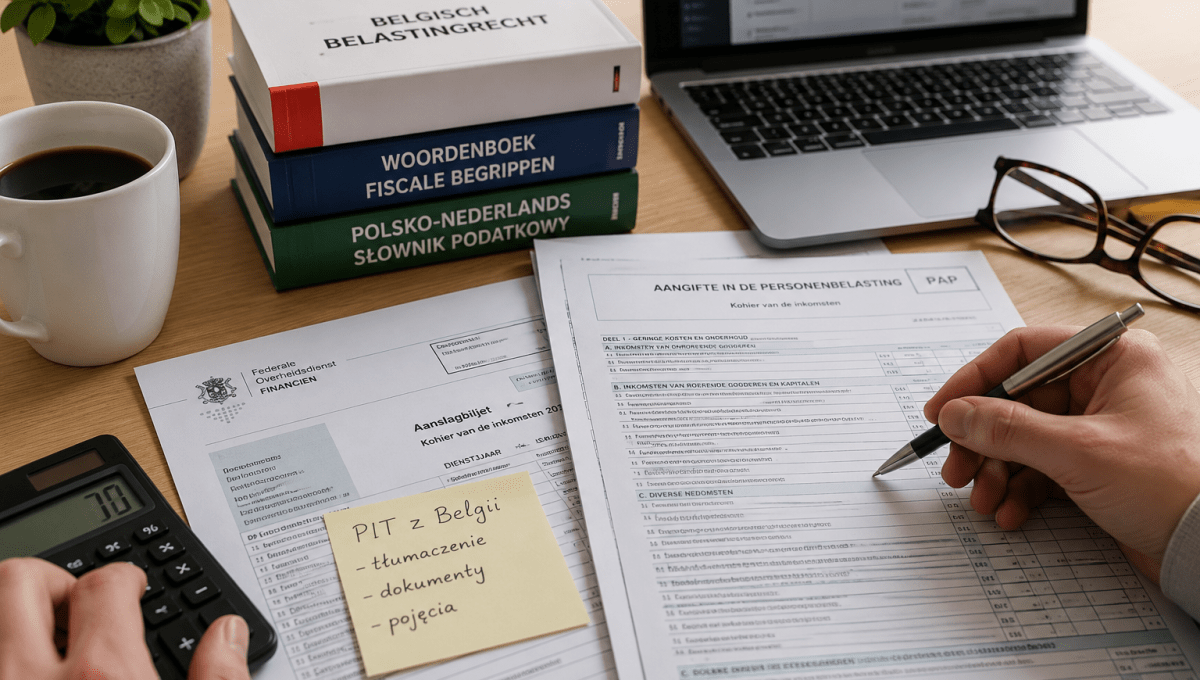
Are you looking for information about what a fiche, loonfiche or loonbrief is and wondering which of these documents corresponds to the Polish PIT? This is a common problem for people working in Belgium. The names vary depending on the official language, and the individual documents serve completely different functions. See what a PIT from Belgium looks like — translations of the most important terms and which documents are really needed when filing taxes.
What is a PIT from Belgium?
A PIT from Belgium is a yearly statement of income received from the employer, i.e. a document called a fiche or loonfiche. It is worth noting that Belgium has several official languages, so the same document may have a different name depending on the region of the country.
You will most often encounter the following terms:
| Document name | What does it mean? |
|---|---|
| Fiche / Loonfiche | Annual statement of income and withheld tax advances |
| Loonbrief | Monthly payslip |
| Déclaration d'impôt / Belastingaangifte | Annual tax return |
Knowing these names makes it much easier to communicate with your employer, accounting office or tax office and allows you to find the correct documents more quickly.
How do fiche, loonfiche and loonbrief differ?
The easiest rule to remember is: fiche and loonfiche refer to the entire tax year, while loonbrief relates to a single payment.
This difference causes the most misunderstandings. Many people try to file their taxes based only on monthly payslips, while the most important document remains the annual tax card.
Fiche (loonfiche) includes, among others:
- total gross salary for the year,
- social security contributions deducted,
- income tax advances,
- bonuses, allowances and other components of remuneration.
Meanwhile, the loonbrief presents data relating to a single payment. You will find there:
- gross salary,
- amount of contributions,
- tax withheld (advance),
- net salary.
If you lose the annual tax card, monthly loonbrief can help reconstruct some data, but they do not replace the fiche and usually do not contain all the information needed for filing.
What does a fiche from Belgium look like? Translation of the most important fields
The most important information appears in the fields concerning income, contributions and tax withholdings. These values are the most important when preparing your tax return.
On the Belgian tax card you should first of all look for:
- total income earned in the tax year,
- amount of social security contributions,
- the amount of income tax withheld,
- information about bonuses,
- allowances and expense reimbursements,
- other benefits reported by the employer.
If the document was issued in Dutch, French or German, a working translation of all headings can be helpful. This makes it easier to verify the accuracy of the data before submitting the declaration.
How is income tax named in Belgian languages and when is document translation required?
The term 'income tax' in Belgian languages depends on the language used in the document. Belgium has three official languages, so the names can differ.
You will most often encounter the following terms:
| Language | Name |
|---|---|
| Dutch | Inkomstenbelasting |
| French | Impôt sur le revenu |
| Tax return | Belastingaangifte / Déclaration d'impôt |
This multilingualism of Belgian administration means many people search online for phrases like Belgium tax translation or income tax in Belgian languages.
For routine verification of data, a working translation that allows you to understand the document's content is usually sufficient. The situation is different when the document must be presented to a government office, bank or other institution that requires official documentation. In such cases, a certified translation by a sworn translator may be required.
With a proper translation, it's easier to avoid misinterpretation of document names, tax codes and individual entries on the Belgian tax card.
How to file a PIT from Belgium and which form should be submitted?
Tax filing in Belgium depends primarily on the taxpayer's residency status. A person residing in Belgium and having the centre of vital interests there files the standard personal income tax return. A worker living outside Belgium but receiving wages, a pension, business income or rental income in that country may be required to submit a non-resident tax return. The document itself, fiche 281.10 or loonfiche, is not a tax return — the data it contains are used to complete the appropriate tax declaration.
The return is most conveniently submitted online via the MyMinfin platform using the Tax-on-web service. After logging in you should check the automatically filled data, compare it with the fiche, loonbriefs and other certificates, add any missing income and deductions, and then confirm submission. The form may appear as belastingaangifte or aangifte in de personenbelasting in Dutch and as déclaration à l’impôt des personnes physiques in French. The return can also be filed on the paper form sent by the Belgian tax authority.
The deadline for submitting the Belgian tax return depends on the form of filing, types of income and the taxpayer's status. A different deadline applies to paper returns than to electronic filing via Tax-on-web, and yet another may apply to people reporting business income, foreign income or directors' fees. You should always check the exact date in the MyMinfin system or on the form received from the Belgian tax office.
Persons who are non-residents of Belgium file using a form known as the non-resident tax return, in French déclaration à l’impôt des non-résidents, and in Dutch aangifte in de belasting van niet-inwoners. Tax-on-web for this group is launched at the beginning of September and the deadline for submitting the return is 20 November 2026. The form can be submitted online or by post. If a taxpayer receives a non-resident return, they should respond even if they believe they had no taxable income — in such a case they should explain their situation in an additional statement.



