
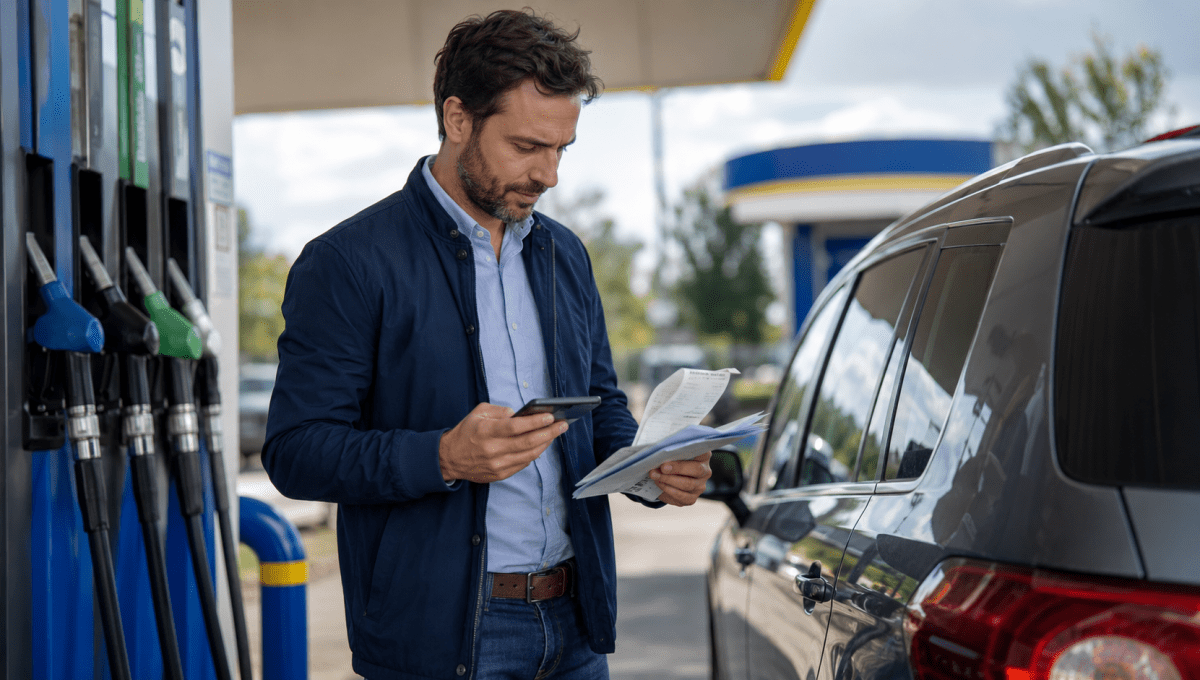
Refuelling abroad does not always have to be just an extra cost for a company. VAT paid on fuel purchased in another EU country can often be reclaimed, provided the fuel was bought for business purposes and the company meets the cross-border refund procedure requirements. Check when a VAT refund for fuel from abroad is available, which documents you must keep and which deadlines to observe so you don’t lose the right to recover the tax.
When can VAT on fuel in the EU be reclaimed?
VAT on fuel in the EU can be reclaimed when the fuel was purchased in another Member State for business purposes, and the company is not locally established as the taxable person for that purchase. This means that it’s not the mere act of refuelling that matters, but its purpose, the documentation and the company’s status in the country where the tax was charged.
In practice the procedure covers situations where an entrepreneur incurs fuel costs while providing services, on business trips, transporting goods, managing a fleet or undertaking other company-related activities. A VAT refund for fuel is not a personal allowance for the driver, but a mechanism for taxable persons conducting business. The refund Member State verifies whether the purchase gives the right to reclaim VAT under its local rules, because that is where the VAT was paid. Directive 2008/9/EC indicates that the refund concerns a taxable person not established in the refund Member State but acting as a taxable person in another Member State.
The main conditions can be summarised simply:
- the fuel must be purchased for business purposes,
- VAT must have been charged in an EU Member State other than the company’s Member State of establishment,
- the company must not have a permanent establishment in the Member State of purchase for those transactions,
- the purchase must be eligible for refund under the rules of the Member State where the fuel was bought,
- the claim must cover the correct period and meet the minimum monetary thresholds.
For transport companies the topic is particularly important because fuel can be one of the largest operational costs. If vehicles regularly refuel in several EU countries, a transport company should treat VAT refunds for fuel as part of fleet cost control, not a one-off formality. With a large number of invoices the differences can be noticeable, especially where a high VAT rate applies.
How does a VAT refund for fuel from abroad work?
A VAT refund for fuel from abroad is made via an electronic claim submitted in the Member State where the company is established, but assessed by the Member State where the tax was charged. This is important because the entrepreneur does not send documents separately to each administration from scratch – they use the electronic VAT refund procedure and the competent Member State forwards the claim.
Deadlines are among the most important points. The claim must be submitted no later than 30 September of the year following the refund period. So if a company refuelled abroad in a given year, documents cannot be postponed indefinitely. After the deadline recovering VAT may be impossible, even if invoices are correct. This deadline is confirmed by both the Your Europe service and the regulations summary on EUR-Lex.
Thresholds also matter. The minimum claim amount is generally 400 euros if the refund period is shorter than a year but covers at least three months. For a claim covering a full year or the final part of a year the threshold falls to 50 euros. These limits are important especially for companies that refuel abroad sporadically and want to check whether submitting a claim is administratively worthwhile.
The simplest scheme looks like this:
| Step | What happens? | What to watch out for? |
|---|---|---|
| Fuel purchase | The company refuels in another EU country and pays the local price including VAT | the document must confirm a business purchase |
| Document collection | Invoices, transaction details, possible vehicle information or fuel card data | not every receipt is sufficient |
| Electronic claim | The company files the claim through the tax administration of its Member State of establishment | deadline by 30 September of the following year |
| Assessment by the refund Member State | The Member State where the fuel was purchased checks the validity of the refund | local restrictions apply |
| Decision and payment | The refund is paid to the account specified in the claim | errors in the data may delay the procedure |
The claim may require details of invoices, suppliers, net amounts, VAT amounts and the type of goods acquired. For fuel the administration may also want to more thoroughly verify documents, as this cost category is often controlled.
Which documents are needed for a VAT refund on fuel?
For a VAT refund on fuel you primarily need a document confirming the business purchase: an invoice or another document accepted by the refund Member State. An invoice is the standard because it most clearly shows who bought the fuel, when the transaction took place, the net amount and the VAT charged.
For fuel the attachment threshold is particularly important. The refund Member State may require an electronic copy of the invoice or import document when the taxable amount is 1,000 euros or more, and for fuel invoices the threshold is lower at 250 euros. This does not mean that smaller invoices are irrelevant. It only means that in many cases they do not have to be attached immediately as a scan, although the data must still be correct and available in case of an audit.
It is safest when the document contains:
- date of purchase,
- seller’s details,
- company buyer’s details,
- net amount,
- VAT amount,
- transaction currency,
- type of expense, i.e. fuel,
- invoice or document number,
- additionally, if required by the country: vehicle registration number, fuel card details or other transaction identifiers.
What about receipts? A VAT refund based on fuel receipts is possible only if the document meets the requirements of the refund Member State. Not every station printout will be sufficient. In some countries a receipt may be accepted for lower amounts or if it contains data that links the purchase to the company. In practice it is therefore better to follow a simple rule: an invoice is the default; a receipt is an exception depending on the country.
The example of the Czech Republic shows well why the whole EU cannot be treated as one form with identical details. The standard VAT rate in the Czech Republic is 21%, so company refuelling amounts to be reclaimed can be significant. At the same time specific documentary and technical conditions still need to be checked for the refund Member State, because the EU procedure does not remove local restrictions.
VAT refund for fuel in the EU – conditions, deadlines and documents in practice
| What to check before submitting a claim? | Which rule applies? | What does this mean for the company? |
|---|---|---|
| Was the fuel purchased for business purposes? | The refund concerns VAT paid on business purchases in another EU Member State. | If the refuelling was personal in nature, it should not be included in a VAT refund claim. |
| Is the company established in the country where the fuel was purchased? | The procedure concerns entrepreneurs who do not have their registered office or a permanent place of business in the refund Member State. | The company reclaims VAT from the country where it incurred the cost, but does not normally account for local VAT there. |
| Where is the claim submitted? | The claim is submitted electronically through the tax administration of the Member State where the company is established. | You do not need to start the procedure directly in every country of refuelling – the claim is forwarded to the refund Member State. |
| Who assesses the right to a refund? | The substantive decision is made by the Member State where the VAT was charged. | Local rules determine whether a given fuel expense entitles a refund. Some countries may impose restrictions. |
| What is the deadline for submitting a claim? | The claim must be submitted no later than 30 September of the year following the refund period. | After the deadline the company may lose the ability to recover the tax, even if it has correct documents. |
| For which period can a claim be made? | The refund period cannot be shorter than 3 months or longer than a calendar year, except for the final part of a year. | Companies that regularly refuel abroad can file claims periodically; for smaller amounts an annual claim is often more convenient. |
| What is the minimum refund amount? | The minimum is 400 euros for a period shorter than a year and 50 euros for a full year or the final part of a year. | Before preparing the claim it is worth summing up VAT from documents to check whether the required threshold has been exceeded. |
| When must a copy of the fuel invoice be attached? | For fuel a copy of the document may be required when the taxable amount on the invoice is at least 250 euros. | Even if a scan is not always required, the document should be kept because the tax office may request additional information. |
| Is a receipt sufficient for a VAT refund on fuel? | An invoice is the norm, and a receipt may be accepted only if it meets the refund Member State’s requirements. | It is safer to collect invoices containing company data, net amount, VAT, purchase date and information that the expense was for fuel. |
| Which expense code is used for fuel? | In the VAT refund procedure fuel is designated with code 1 – Fuel. | The correct code facilitates expense classification and reduces the risk of formal errors in the claim. |
How does VAT on fuel purchased abroad differ from excise duty refunds?
VAT on fuel purchased abroad and excise duty are two different mechanisms, so they should not be combined in one claim or described as the same relief. VAT is reclaimed under the value added tax refund procedure, while excise duty may be subject to separate rules in certain Member States and only if additional conditions are met.
Simply put: a VAT refund for fuel concerns the tax charged on the invoice for the fuel purchase, while any excise duty refund concerns the excise element included in the fuel price. For carriers this can be important, because with high mileage both issues may arise side by side. However, one should not assume that because a company can reclaim VAT it will automatically recover excise duty as well.
For excise duty other criteria often matter, such as:
- type of transport,
- vehicle weight,
- type of fuel,
- method of payment,
- local rules of the Member State of purchase,
- additional forms and deadlines.
Therefore when refuelling abroad it is best to separate the actions. First check whether the purchase qualifies for the VAT refund procedure. Then separately assess whether a path to excise duty recovery exists in the given country. For a transport company such an approach reduces the risk of errors, because the most common problems do not stem from the refuelling itself but from documents, deadlines, thresholds and local exceptions.



